Your Holiday Collection Doesn't Have to Arrive All at Once
TL;DR
Holiday inventory rarely lands in one tidy shipment, and trying to hold it all for a single grand reveal wastes both the early arrivals and your customers' attention. Plan a few small, coherent drops around whatever your vendors actually deliver, and give each one a complete look and a clear reason to shop now. Ohavah lists each shipment the day it arrives, straight from the supplier invoice, so a staggered delivery calendar turns into a steady run of drops instead of a pile-up in the stockroom.
Turn supplier invoices into products instantly
Skip the manual data entry. Upload a PDF, get ready-to-import products.
You planned the holiday buy months ago as one collection, and in your head it arrives as one collection: the whole look, complete, ready to reveal the day after you flip the calendar. Then reality shows up the way it always does, one shipment early, two more scattered across three weeks, and a backorder that lands the week before Christmas. The collection you bought as a set arrives as a trickle.
Fighting that trickle is where a lot of the season's stress comes from. You either hold the early boxes waiting for the rest, which parks paid-for inventory in the back during your best selling weeks, or you put things out piecemeal with no plan, so the floor looks half-finished and nothing tells a story. There's a better option than either, and it starts with accepting that the deliveries were never going to be tidy.
Deliveries were always going to be messy
Split shipments and shifting dates aren't a sign anything went wrong. They're how the supply chain works, especially for the smaller brands boutiques love to carry. Production runs finish at different times, freight gets delayed, and a vendor ships what's ready rather than sitting on the first half of your order. We wrote a whole piece on why deliveries shift and what buyers can do, and the short version is that you should plan for staggered arrivals as the normal case, not the exception.
Once you stop expecting one clean drop, the scattered deliveries stop being a problem to manage and start being a rhythm to use. A collection that arrives in three waves can sell in three waves, and three reasons to come in beat one.
Why the one-big-reveal plan backfires
Holding everything for a single launch feels disciplined, like you're building anticipation. In practice it usually costs you on both ends.
The early arrivals age in the stockroom while you wait for the stragglers, which means the pieces that shipped first, often your strongest sellers, lose their best full-price weeks sitting in a box for a launch date that keeps slipping. And when the big reveal finally happens, you've asked your customers to absorb the entire collection in one visit, which is more than anyone shops in one trip. They see it once, buy a piece or two, and the rest reads as old news by their next visit even though it only just went out.
A single drop also gives a customer exactly one reason to come in. Spread the same inventory across a few well-timed releases and you've got several. Each new wave is a fresh reason to visit, a new reason to create a little hype, and another chance for someone who wasn't ready last time to catch the piece that finally lands their size.
Build the drops around what shows up
The plan isn't to invent arbitrary launch dates and then force product to fit them. It's to look at your delivery calendar, rough as it is, and group whatever's arriving into a handful of coherent releases.
Start with what you know. If the knits and outerwear are landing first, that's your first drop, a cold-weather layering story you can build a window and a post around. If the party dresses and occasion pieces are slated for mid-season, that's a second drop timed to when people actually shop for events. The backordered accessories that always come late can be their own small "just in" moment closer to the gift-buying weeks, when a shopper wants something easy to grab. You're not fighting the freight schedule, you're naming the groups it's already handing you.
Aim for a few drops with real gaps between them rather than a new arrival dribbling out every couple of days with no shape. A drop needs enough behind it to feel like an event and enough breathing room that your regulars notice the difference between this visit and the last.
Make each drop worth showing up for
A drop only works if it hangs together. A dozen unrelated pieces going out on the same day isn't a release, it's just restocking. What makes a customer stop and shop is a wave that reads as a complete idea.
Give each one a spine. Merchandise it as an outfit story rather than a rack of singles, so a shopper sees the whole look and not just one top she has to imagine styling. Build in the pieces that go together on purpose, because a drop with the layering piece, the bottom, and the finishing accessory sitting side by side is the same thing that makes sets and layering raise your average order. One coherent drop of fifteen pieces that tell a story will almost always outperform thirty pieces dumped out with no through-line.
Even when the shipment itself is a mixed bag, you can still cut it into coherent moments. Hold the odd pieces that don't fit this drop's story and fold them into the next one where they do. You bought a collection; releasing it in chapters lets each chapter make sense.
Give people a reason to shop now
A drop with a date and a story still needs a nudge to turn a browser into a buyer this week instead of someday. That's what turns a staggered delivery calendar into a series of small selling events rather than a shelf that slowly fills up.
Tie each release to a reason to act. A preview for your best customers the night before it hits the floor, a styling event around the party-dress drop, a short window where the first people in get first pick of the sizes. These are the kinds of boutique events that actually drive sales, and they work far better attached to a specific, coherent drop than floated over a vague "new stuff is in." Give the wave a name, a date, and a look, and you've given people something to plan around.
List each drop the day it lands
None of this works if the product can't go live when the drop goes live. A staggered plan only pays off if each wave is ready to sell, in the store and online, the moment you announce it. The failure mode is a drop you've hyped all week that isn't actually on your site yet because the shipment is still waiting to be listed, so the customer who saw your post goes looking and finds nothing.
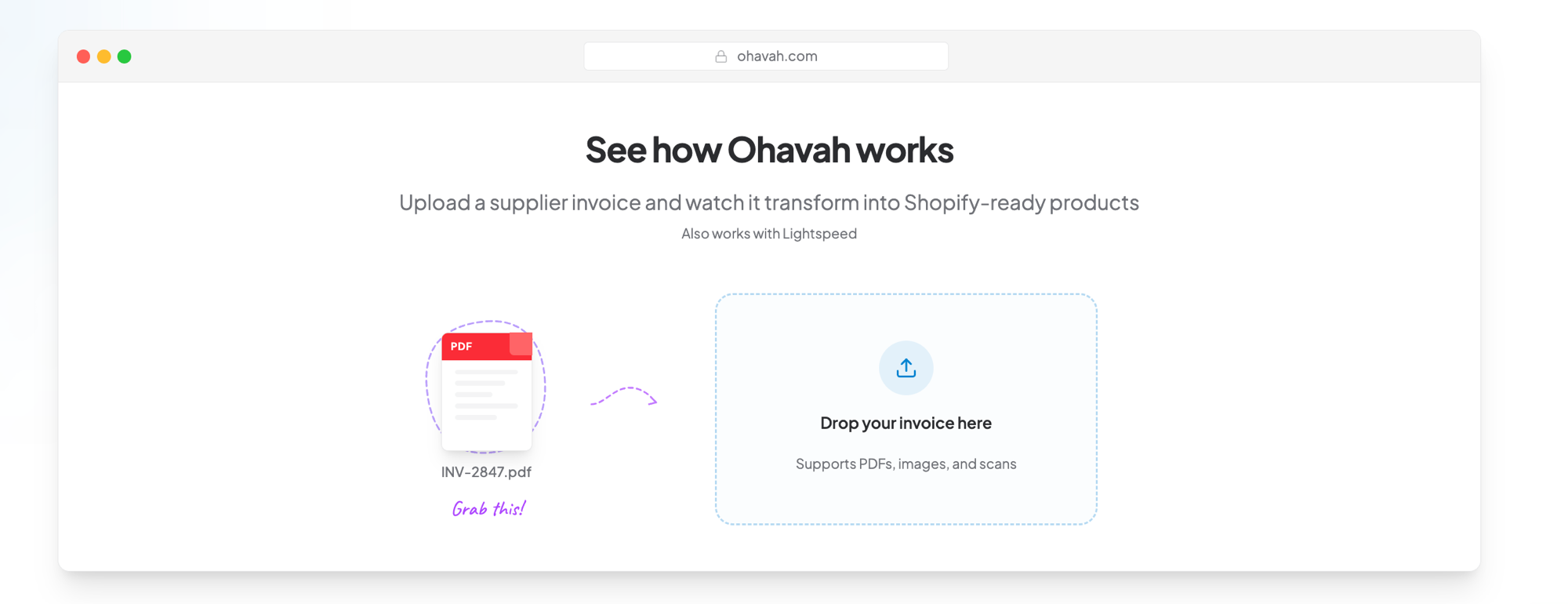
Getting each shipment listed fast, instead of letting boxes queue up, is what makes the staggered plan pay off. When a delivery lands, upload the supplier invoice and Ohavah turns it into ready-to-import Shopify products in minutes, so the drop you're promoting is live the same day. Staggered arrivals stop being a backlog and become exactly the steady cadence of releases you planned, which is the flip side of what those boxes cost you when they sit unlisted. Your online store is a second location, and every drop should open in both places at once.
Boutiques running their season this way tell it in their own words over on our customer stories. Here's Lacy from Willowmere Boutique:
Sketch the season as a few drops
Before the first holiday box arrives, take your rough delivery calendar and pencil in three or four drops with dates, a one-line theme for each, and the reason a customer should come in for it. It doesn't have to be right. It has to exist, so that when a shipment lands early or late you're slotting it into a plan instead of scrambling to react.
The collection you bought as one thing will still sell as one thing across the season. Releasing it in chapters just means each chapter gets its own moment and its own full-price weeks, with a fresh reason for someone to walk in the door.
Try Ohavah free for 7 days and list each shipment the day it arrives, so every drop in your holiday plan is ready to sell the moment you announce it.