How to Write Product Pages for the Questions Shoppers Ask AI
TL;DR
Shoppers are starting to describe what they want to an AI instead of typing keywords: "a non-itchy sweater I can wear in a warm office," not "wool sweater." The pages these assistants recommend tend to be the most specific, and often the most honest, rather than the prettiest or the most keyword-stuffed, because the assistant is cross-checking your description against reviews, the manufacturer's spec, and the other stores selling the same item. That reverses an old habit. Vague praise used to be harmless; now it's a reason to get skipped. The counterintuitive move is to write the things retail is trained to hide, starting with who a product isn't for. Ohavah gets the boring half right, turning your supplier invoice into accurate listings with correct titles, variants, SKUs, and tags, so your time goes to the honest specifics that actually win the recommendation.
A shopper used to open your store, type "black sweater," and scroll. Now a growing number of them ask ChatGPT, Google's AI Mode, or Perplexity something closer to how they'd ask a friend: "I need a black sweater that isn't itchy and won't cook me in a heated office." The assistant reads that, goes looking through whatever product data it can reach, and hands back a short list of specific items with reasons attached.
Here's the part that catches boutiques off guard. The listing that wins that spot is often the plainer one: the page that happened to say "lightweight cotton, breathes well, good for an overheated office," while the gorgeous merino you were sure would win got passed over because nothing on its page ruled out the one thing the shopper was worried about. Specific beat pretty, and a page willing to say what a piece isn't great for beat three pages that only listed how wonderful everything is.
That's a different game than SEO, and it's worth understanding what actually changed before you rewrite a single description.
Does "optimizing for AI" mean a new kind of keyword stuffing?
No, and that's the first thing to get straight, because a lot of the advice now showing up under "AEO" or "get your store ready for AI" is the old search-era playbook with a fresh coat of paint. You can't win an AI recommendation by cramming "cozy soft warm comfortable knit" into your description the way you once stuffed a meta tag. The models reading your page match the meaning of a question against the claims you make, and density doesn't impress them. They're also, increasingly, reading straight past your description.
When an assistant sizes up your sweater, your own copy is one input among several. It can see the reviews on that product, the manufacturer's spec, and the same style sold by other retailers who might describe it more precisely than you do. A human shopper skims and extends you the benefit of the doubt. An assistant with five sources open notices the gap between "a must-have staple you'll reach for all season" and a review two lines down that says "thinner than I expected."
So what gets rewarded is drifting toward specific, checkable claims and away from praise nobody can verify. Call it honesty turning into a ranking signal. "Midweight, holds its shape, runs a half size large" gives the assistant something to match and nothing to contradict. "A must-have staple you'll reach for all season" gives it nothing to match and plenty to second-guess. The first reads like a knowledgeable associate; the second reads like every other tab the shopper has open.
Write the part retail is trained to hide
Here's the uncomfortable, useful move. The most valuable sentences you can add to a product page are often the ones that disqualify the wrong buyer.
Boutique instinct says never write anything that might talk someone out of a sale, so listings describe the best version of everything and go quiet on the rest. But shoppers ask disqualifying questions all day: is this warm enough for a Chicago winter, is the white one see-through, will this swallow me at five foot two. A page that honestly answers "no, this one's a transitional-weight layer, not a true winter coat" doesn't lose the sale. It loses the wrong sale, the one that was coming back as a return anyway, and it wins the shopper who wanted exactly a transitional layer and now has a reason to trust you.
AI shopping sharpens the point, because those disqualifying questions are precisely what people type into an assistant: not sheer, true to size, good for petites. If your page is the only one that addresses the thing a shopper is anxious about, you're the answer. If it's one more wall of praise, the assistant has no reason to pick you over all the other walls of praise, so it goes and finds the store that was specific.
None of this means running down your own product. It means describing it the way the person on your sales floor does, the one who tells a customer "runs small, size up" or "it's lined, not sheer, but it's dry clean only." Each of those is a detail a careful shopper filters on and an assistant can surface, and each earns the kind of trust that makes your next recommendation easier.
Get the facts right before you write a word of description
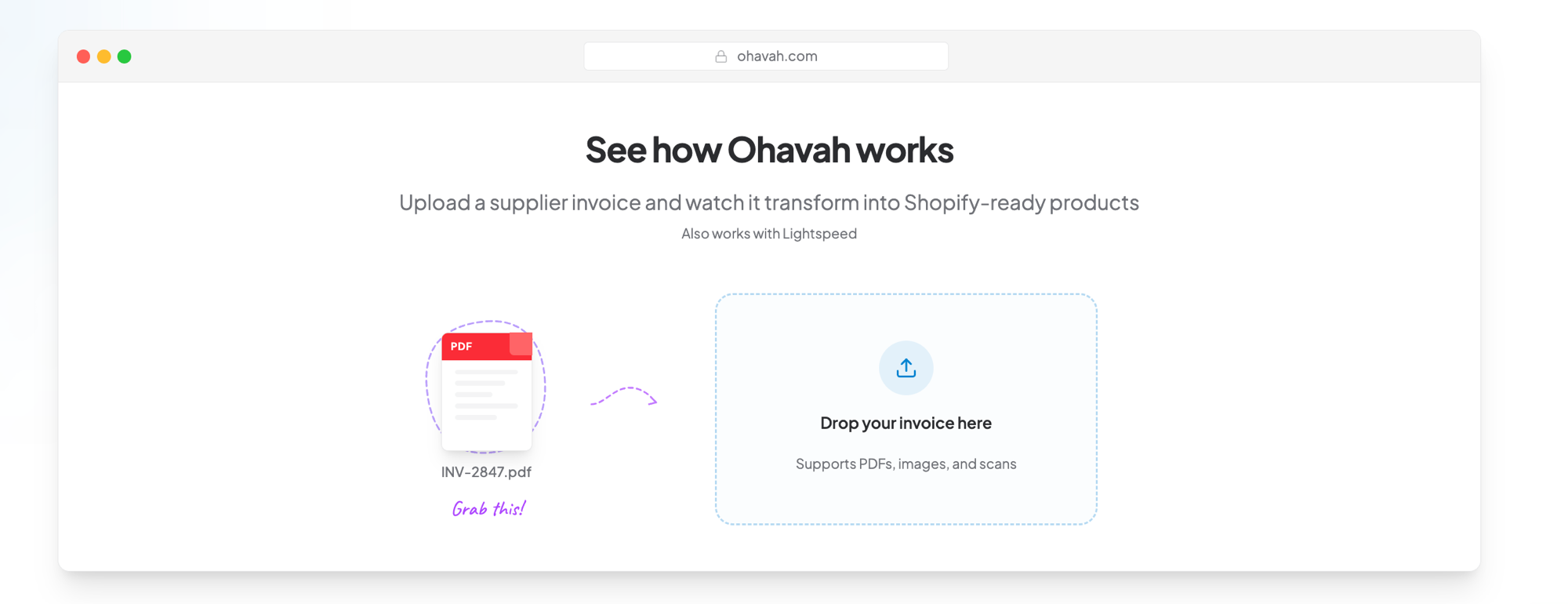
Ohavah turns your supplier invoice into accurate listings, with the right titles, every size and color, SKUs, and tags filled in from the order, so the attributes an AI reads about your products are correct from the start.
 Lacy · Willowmere BoutiqueCalled it “an absolute game changer” for launching her new website.See Lacy’s story →
You don't fully own your product page anymore
When you and five other boutiques carry the same brand's dress, the assistant knows it's the same dress. We've written before about what happens when two boutiques sell the same dress, and AI raises the stakes. Faced with one item and several sellers, an assistant can pull the richest, most trustworthy description from whichever store wrote it, then recommend that store. You can lose a recommendation on a product sitting in your own stockroom because a competitor described it better, or because their reviews answered a question yours left open.
That cuts both ways, which is the opening. The brand's own copy is usually generic, and most retailers paste it in untouched. The boutique that adds the honest, lived-in detail (how it actually fits, who it's for, who it isn't) becomes the best source for that item even if ten other stores sell it at the same price. The thing your best associate knows that your website doesn't is the one input a competitor can't copy off the brand sheet.
The practical version: answer the questions shoppers ask, verify everything
Strip away the strategy and the day-to-day is simple. Spend a week writing down the questions you actually get, in DMs, on the floor, in reviews. They cluster around fabric, fit, and where you'd wear the thing, and each one is a detail you can add:
- Fabric and weight answer "will it itch" and "will I overheat." Write the fiber content and whether it's a layer or a statement piece, not "soft," because every sweater on the internet claims soft.
- Fit answers "how does it run" and "what does it look like on a body." "Runs true, relaxed through the body, hits at the hip on a five-foot-six model" beats a paragraph of adjectives, and it pairs well with an on-body photo and a close-up.
- Occasion answers "can I wear this to X." Name where it works and resist the urge to claim it works everywhere.
That last one is the new keyword stuffing. "Perfect for the office, date night, weekends, travel, and lounging" is occasion stuffing, and an assistant routes around it the same way it ignores a wall of keywords. One honest "works at the office under a blazer, dressed down on the weekend" beats five aspirational occasions you can't stand behind.
Under all of it sits one rule. Only write what you can verify from the garment or the supplier's spec. A guessed detail that turns out wrong comes back as a return and a bad review, and that review is now feeding the same assistant you were trying to win. Guessing used to risk one customer. Now it poisons the data every future shopper's AI reads about you.
Should you rewrite your whole catalog for this? Probably not yet.
Here's the honest hedge, because the internet is about to fill up with people telling you AI shopping is an emergency. For most boutiques it's a small and uncertain slice of traffic today, and nobody can tell you how fast it grows or exactly how these assistants will weigh your page a year from now. Tearing apart a two-thousand-product catalog to chase it would be a bet on a future nobody can see clearly.
The reason to do the work anyway is that it isn't much of a gamble. Accurate product data and honest, specific descriptions are the same thing that lowers your return rate, answers the questions that stall a sale, and makes human shoppers trust you, all of which pay off whether or not a single customer buys through ChatGPT. You're doing the fundamentals, and the fundamentals happen to be exactly what this new reader rewards too. Start with your best sellers and your highest-return styles, write them like you're walking an actual customer through the piece, and let the rest follow.
If AI shopping fizzles, you're left with a tighter catalog and fewer returns. If it takes over, you're already the store that told the truth. Either way the work points the same direction, which is a rare thing to be able to say about anything in retail right now.
Get the boring half right, so your judgment goes to the rest
All of this assumes the facts under your descriptions are correct to begin with: the right fiber content, the colors you actually stock, every size you ordered, the correct SKU for the actual item. If half your variants never made it onto the page or your vendor's color names are a mess, the honest copy on top won't save you, because the assistant is reading wrong facts stated nicely.
Ohavah handles that half. Upload the supplier invoice and it reads every line item and builds accurate listings with correct titles, size and color variants, SKUs, pricing, and tags pulled straight from the order, ready to import into Shopify, with the matching product images if you want them. The structured foundation lands in minutes instead of over an afternoon, and the time you'd have spent retyping line items goes to the part no tool can do for you: the honest, specific, slightly unflattering detail that makes your page the one an assistant trusts.
None of the AI tools in Shopify's growing stack can pull a shopper toward a page that doesn't answer her question, and none of them can make a dishonest page honest. Give the page a straight answer, including the inconvenient parts, and build it on data you didn't have to type by hand.
Try Ohavah free and start your next shipment's listings from accurate data.
Related next steps
LacyWillowmere BoutiqueCalled it “an absolute game changer” for launching her new website.