The Do's and Don'ts of Using AI in Your Boutique
TL;DR
AI earns its keep on the parts of running a boutique that are repetitive and reversible: cleaning up a supplier spreadsheet, drafting a product description you'll edit, rewriting the same email for the tenth time. It gets you in trouble the moment you let it state a fact about a physical garment it has never touched. Fiber content, care instructions, measurements, and claims like "true to size" are things AI will fill in confidently and sometimes wrongly, and a wrong one comes back as a return or a bad review. The safe rule is simple. Let AI shape words and organize information, and never let it originate a fact. Ohavah handles the fact-heavy half for you, reading your supplier invoice into accurate listings with the right titles, variants, SKUs, and tags, so anything AI writes on top is sitting on data that's actually true.
A lot of boutique owners are already using ChatGPT, to write a description at 11pm, to clean up a vendor's chaotic order confirmation, to come up with captions for the week. That's a reasonable instinct, because a one- or two-person shop is drowning in small writing and sorting tasks, and this is the first tool in years that actually chips away at them.
The trouble is that AI is equally happy to do the two things it's good at and the one thing it's terrible at, and it does all three in the same confident voice. It'll draft a lovely description, and in the same breath tell you the sweater is 100% cotton when the tag says cotton-modal, because "100% cotton" is the statistically likely thing to say about a sweater and the model has no idea what's in the box on your stockroom floor. You can't hear the difference in its tone. Both sentences read like it knows.
So the useful question is which jobs you can hand AI, and which ones will cost you money if you do.
The line that sorts every task
Before you give AI anything, ask one question about the output: does this make a claim that has to be true about a physical item?
If the answer is no, you're in safe territory. Tone, structure, a first draft you're going to react to, turning your bullet points into a paragraph, sorting a messy list, summarizing a long supplier email. The worst case is awkward phrasing you fix in ten seconds.
If the answer is yes, you've crossed the line. Fiber content, wash instructions, measurements, country of origin, whether something runs small, whether the white one is see-through. These are facts about an object the AI cannot see, and its best guess is a liability dressed up as an answer.
Everything below is just that one question applied to the jobs you actually do.
The do's: hand AI the repetitive, reversible work
Organize messy supplier information. Vendors send you order confirmations in every format imaginable, from a tidy spreadsheet to a photographed packing slip to a wall of text in an email. Pasting that into an AI and asking it to pull out the style names, colors, and quantities into a clean table is a good use, because you're asking it to reorganize information you gave it, not to invent anything. You still check it against the source, but it saves the tedious retyping.
Draft copy you're going to edit. A blank description field is the slowest part of listing anything. Giving AI the actual details (the fiber content off the tag, the measurements you took, who it's for) and asking for a first draft in your store's voice is fair game, as long as you treat the result as clay. The facts have to come from you. The AI's job is to arrange them and make them read well, and then you cut the two adjectives that sound like every other store.
Handle the repetitive writing. The restock email you send twenty times a season, the FAQ answer about your return policy, three caption options for a new arrival, a polite reply to a customer asking if something's back in stock. This is high-volume, low-stakes writing where a draft to react to beats a blank screen, and nothing rides on a fact the AI had to make up.
The thread through all of these is that AI touches the words and the arrangement while a human owns the truth, and nothing goes live without a person reading it first. Used this way it's a fast junior assistant who writes quickly and should never be trusted with a measuring tape.
The don'ts: never let it originate a fact about a garment
The expensive mistakes start here, and they're subtle enough to slip through a tired late-night review.
Fabric composition. Ask AI to "write a description for this sweater" without giving it the fiber content and it will supply one, because its training says sweaters are usually some confident blend of cotton or wool. If it guesses "100% cotton" and the tag reads 60% cotton, 40% modal, you've published a false claim. A customer with a wool sensitivity, or one who machine-washes it on the strength of "100% cotton," has a fair complaint and a reason to return it.
Care instructions. This one burns people. "Machine wash cold, tumble dry low" is the most common care line in existence, so it's exactly what AI reaches for, and it's exactly wrong for the delicate rayon or the dry-clean-only blazer. A shopper who follows your AI-written care label and ruins a $120 piece isn't coming back, and they're not staying quiet about it either.
Sizing and measurements. AI does not know the inseam, the bust, or whether this particular brand runs small. If you ask for "fit details" it will produce plausible-sounding ones, and a confident "runs true to size, hits at the hip" on a top that actually runs two sizes small is how you earn a closet full of returns. Measurements come off the garment or the spec sheet, and nowhere else.
Product claims. "Ethically made," "sustainable," "handmade," "locally sourced," "organic cotton." These are claims with legal and trust weight, and an AI will cheerfully attach them because they test well in marketing copy. If you can't back a claim from the supplier's documentation, it doesn't go on the page, no matter how nicely the draft put it.
Notice that none of those errors look like errors. They're the boring, likely, plausible thing to say rather than the hallucinated nonsense you'd catch instantly, which is precisely what a language model is built to produce and precisely what a quick skim won't flag.
The review habit that makes AI safe
The fix is one small ritual you build around anything AI writes. Before a word goes live, check every factual claim against a source that actually knows: fiber content against the tag or the invoice, care against the label, measurements against the garment, and any claim against the supplier's paperwork.
Read an AI draft with a specific suspicion, assuming any concrete fact might be invented until you confirm it, and the subtle mistakes stop slipping through. Tone, grammar, and flow you can trust the AI with. Any noun or number that describes the physical item gets verified. That single pass is the difference between AI saving you an hour and AI costing you a string of returns.
Let AI write, but build it on facts you didn't have to type
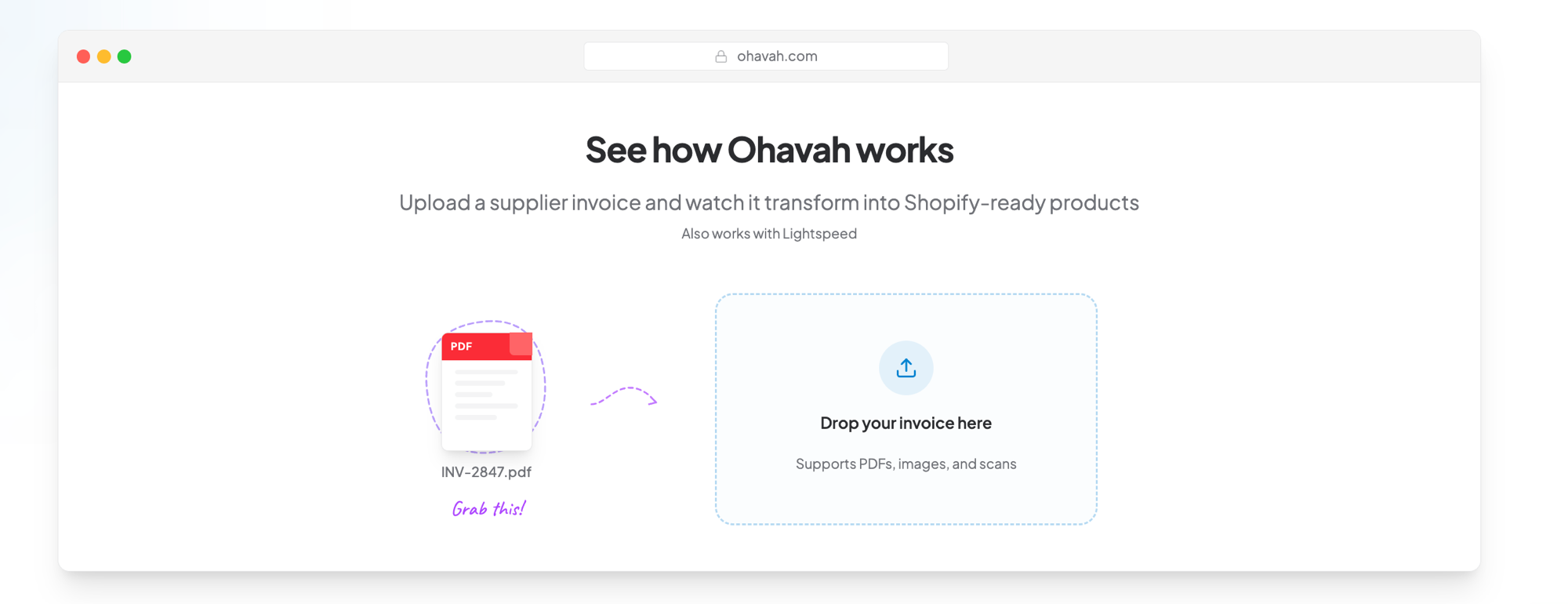
Ohavah turns your supplier invoice into accurate listings, with the right titles, every size and color, SKUs, and tags filled in from the order, so any copy you or an AI tool write sits on data that is actually true.
 Lacy · Willowmere BoutiqueCalled it “an absolute game changer” for launching her new website.See Lacy’s story →
There's a newer reason this matters, too. When a shopper asks ChatGPT or Google's AI Mode for "a non-itchy sweater for a warm office," the assistant reads your product page as data, and it cross-checks your copy against reviews and the brand's spec. We dug into how shoppers are asking AI instead of typing keywords, and the short version is that a wrong fact on your page no longer misleads just one customer. It becomes a wrong fact an AI repeats to every future shopper who asks, until a review contradicts you and the assistant stops trusting your listing. The AI-written error you didn't catch is now feeding the AI your next customer is asking.
Get the facts right first, then let AI do the rest
Every "don't" above has the same root. AI makes things up when it doesn't have the data, so the most useful move is to make sure the data is there before AI ever sees the page.
Ohavah does that half for you. Upload your supplier invoice and it reads every line into an accurate listing, with the correct titles, every size and color variant, SKUs, pricing, and tags pulled straight from the order instead of guessed. The fiber content, the colors you actually stock, and the correct SKU for the actual item are all grounded in the document, so when you or an AI tool write the description on top, it's dressing up facts that are already true rather than inventing them. If your vendor's color names are a mess or half your variants never made it onto the page, no amount of polished copy will save the listing, because the problem was never the words.
Used with that division of labor, AI is one of the better things to happen to a stretched-thin boutique in a while. It drafts, it organizes, it handles the hundredth version of the same email, and it leaves the facts about your actual merchandise to the people and the paperwork that know them. Let it write. Just don't let it remember things it was never told.
Try Ohavah free and start your next shipment's listings from accurate data.
Related next steps
LacyWillowmere BoutiqueCalled it “an absolute game changer” for launching her new website.