The Hidden Cost of Overstock
TL;DR
The wholesale cost of overstock is the part you can see. The hidden costs are bigger:
- Carrying costs run 15-25% of inventory value per year in tied-up capital, shrinkage, insurance, and space
- Every dollar stuck in dead stock is a dollar that can't be spent on proven sellers
- Clearing overstock through markdowns trains customers to wait for sales
- The Sunk Cost Fallacy keeps owners holding inventory long after it stopped earning its space
The cheapest overstock is the kind you never accumulate, which comes down to disciplined buying and getting products selling everywhere from day one. Ohavah helps with the second part by turning supplier invoices into Shopify-ready listings in minutes.
Turn supplier invoices into products instantly
Skip the manual data entry. Upload a PDF, get ready-to-import products.
Walk into the back room of almost any boutique and you'll find it: the rack of last season's styles waiting for a sidewalk sale, the boxes from a brand that didn't land, and the size runs that are all smalls and extra-larges because the mediums sold out a year ago.
Most owners mentally file this inventory under "money I already spent," shrug, and move on. After all, the worst case is selling it at cost eventually, right?
The worst case is actually quite a bit worse than that. Overstock keeps charging you long after the invoice is paid, and the meter runs in ways that never show up as a line item.
The cost you can see
Start with the obvious part. For an independent boutique, carrying inventory costs somewhere around 15-25% of its value per year, built from concrete line items; the cost of the capital itself (interest on a line of credit, or your own cash earning nothing), the shrinkage and damage that accumulate while product sits, the insurance on stock you're holding, and the back-room or storage-unit space it occupies.
Take $20,000 in aging inventory, a very normal figure for an established boutique, and that's $3,000 to $5,000 a year just to keep owning it. Holding the rack for "someday" isn't free; it's one of the more expensive subscriptions you have.
The cost you can't see
The bigger damage is what that money isn't doing.
Retail runs on turns. A dollar spent on a product that sells through quickly comes back as roughly two dollars, ready to be spent again; a healthy boutique turns its inventory three or four times a year, earning margin on every pass. A dollar parked in overstock cycles zero times.
This is opportunity cost, and for a boutique it's brutal because open-to-buy is always the constraint. The $8,000 sitting in last spring's slow movers is exactly the $8,000 you wish you had when your best-selling brand drops a new collection, or when a reorder on a proven style would sell through in three weeks. We've written about how to tell when to reorder versus move on; overstock is what happens when that decision gets deferred for too long, and the price of deferring is paid in winners you couldn't buy.
There's a second-order effect too. A back room full of old inventory makes you hesitant at market, so you under-buy the new season to compensate, and now the overstock is shaping your assortment a full year after the original buying mistake. Walking into market already behind is one of the classic buying mistakes, and overstock is usually how it starts.
The markdown spiral
Eventually the rack gets cleared the way it always does, with a sale. And clearing overstock through aggressive discounting has its own hidden cost; it teaches your customers how your store works.
If your regulars learn that everything eventually hits 40% off, they start waiting. Full-price sell-through drops, which creates more aging inventory, which creates more clearance events, and the cycle feeds itself. We covered the mechanics in why discounting too early hurts your store, but the overstock version is worse because clearance pricing on a big rack of old product anchors your whole store's perceived value, not just one style's.
That's the full bill for overstock; you pay to carry it, you pay in the winners you couldn't fund, and then you pay one more time in eroded pricing power when you finally let it go.
Why we hold on anyway
If overstock is this expensive, why does every boutique have some? Because letting go feels like losing money, and keeping it feels like deferring the loss.
This is the Sunk Cost Fallacy working exactly as designed. The $30 per unit you paid is gone whether the product sells tomorrow or sits for another year, but it doesn't feel gone while the product is still on the rack. Marking it down to $25 makes the loss official, so owners keep it at full price instead, where it sells at a rate of roughly never, and the carrying costs quietly compound the original mistake.
The accounting view is clearer than the emotional one. Instead of asking what you paid for the product, ask what that dollar will earn over the next six months sitting on the rack, versus converted to cash and spent on something proven. Asked that way, last season's styles almost never win.
Getting out from under it
If you're holding aging inventory now, the playbook is to move it decisively rather than gradually. A single meaningful markdown that actually clears product beats months of timid 15% gestures that just extend the carrying costs. Bundle slow movers with bestsellers to protect blended margin, push them hard during slow-season promotions when you need traffic anyway, and treat anything that survives two full-effort clearance attempts as a donation receipt rather than an asset.
Then redirect the recovered cash into your proven performers immediately, so it starts turning again instead of sitting in your checking account waiting to become the next overstock.
The cheapest overstock is the kind you never buy
Prevention is where the leverage is, and it has two halves.
The first half is buying discipline; firm budgets, sell-through data informing every reorder, and a cap on how much you gamble on unproven brands. The second half gets less attention but matters just as much, and that's making sure everything you buy gets a full chance to sell.
A surprising amount of overstock was never slow product to begin with. It was product that arrived late and then sat for weeks in the back room waiting for data entry, never made it onto the website, or got listed online a month after the in-store customers had already seen it. By the time it was available everywhere, its peak demand window had passed, and from there it aged into the clearance rack. Your online store is a second location, and product that never reaches it is selling to half an audience.
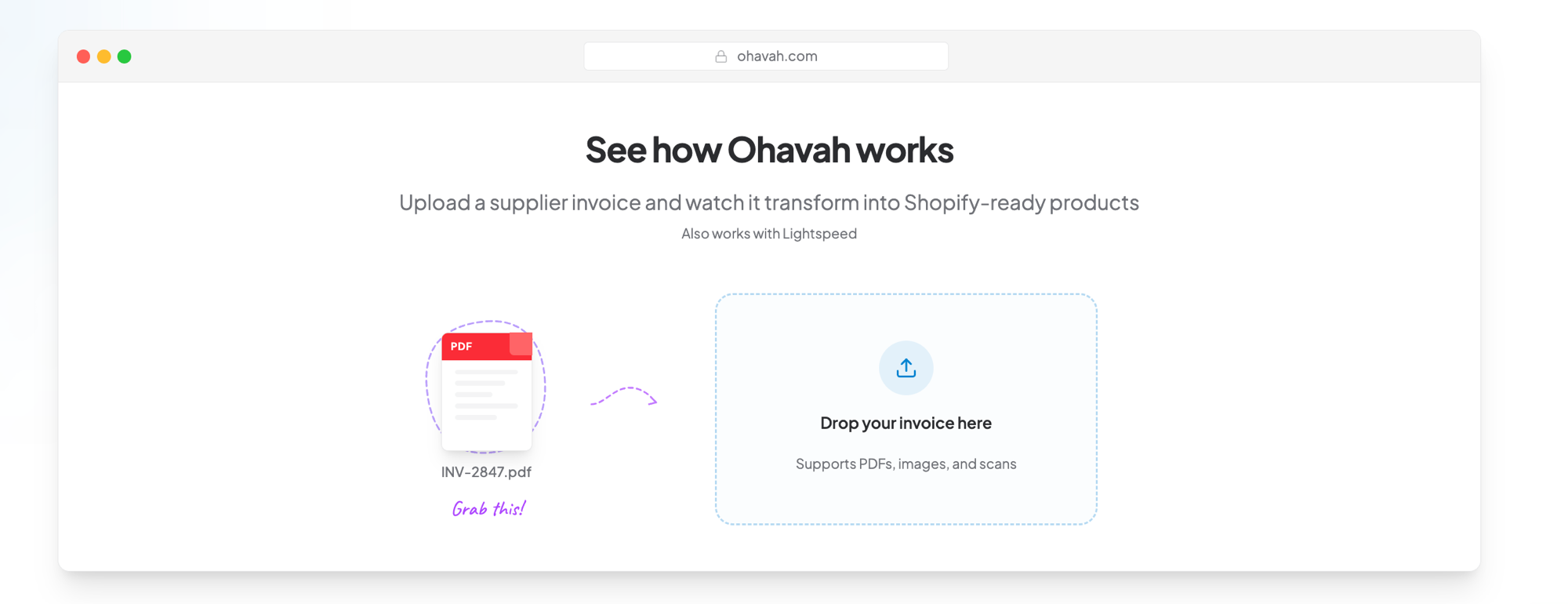
Ohavah closes that gap by turning supplier invoices into Shopify-ready import files, with variants, pricing, and tags built automatically. New arrivals go live online the same day they arrive, every product gets its full selling window on every channel, and less of your buy ends up on the rack in the back room charging you rent.
Try Ohavah free for 7 days and stop paying for inventory twice.