The Boutique Gift Guide for Someone Who's Never Shopped With You
TL;DR
For six weeks around the holidays, a big share of your traffic is people buying for someone else, a husband, a grown kid shopping for mom, a coworker who drew a name in the office exchange. They don't know your brands and they don't know their person's size, so the store you've merchandised for your regulars leaves them lost. Build a gift guide that leads with forgiving picks (accessories, one-size knits, loungewear, candles), describe each one the way a gift-buyer needs, dimensions, feel, packaging, and whether it works for a closet they can't see, and make gift receipts and returns obvious so the fear of getting it wrong stops blocking the sale. Ohavah builds your product catalog straight from the supplier invoice, so once your holiday buy is listed with its colors and sizes, grouping gift-friendly pieces into a guide is a quick sort instead of a data-entry project.
Turn supplier invoices into products instantly
Skip the manual data entry. Upload a PDF, get ready-to-import products.
A man walks into your store the second week of December holding his phone, looking a little panicked. He's buying for his wife, and all he's sure of is that she likes your shop because she's mentioned it. Her size, the brands she reaches for, whether she'd wear the green or decide it washes her out, he couldn't tell you any of it. He's one of a whole category of shoppers you see this time of year: the partner, the grown kid buying for a parent, the coworker who pulled a name and has a twenty-dollar cap and no idea where to start.
These shoppers spend money, often more than your regulars do, because a gift has a number attached to it and most people would rather clear the bar than come in under it. But they're buying with a handicap your usual customer doesn't have. She knows the fit runs generous, knows the modal washes soft, knows she's a small in one line and a medium in another. The gift-buyer knows none of that, and if your store won't hand him the information, his fallback is a gift card or the mall, where the sizing at least feels safe.
Your store is built for the regular, not the gift-buyer
Walk your own floor as if you'd never been inside. The displays assume taste you already share, the tags assume you know your size, and the online descriptions lead with fabric content and care instructions, the stuff a returning customer wants, and skip the question a gift-buyer is stuck on: will this be right for a person I love, and what happens if it isn't. You've merchandised for the shopper who already trusts you. The gifter needs a different set of answers before the card comes out.
Lead with gifts that are hard to get wrong
The most useful thing you can do for a nervous gift-buyer is point them straight at the things that don't hinge on a size. Put those first, on the floor and online, and label them plainly as giftable.
- Accessories. Scarves, jewelry, a hat, a good crossbody. Nothing here has to fit a body, and it still looks like something you picked on purpose.
- One-size pieces. A wrap, a ruana, an oversized cardigan that's meant to be roomy. Forgiving by design, so the gifter can't land on the wrong number.
- Loungewear and socks. Robes, a cozy set, cashmere socks. The sizing is soft, usually S/M and L/XL, and almost nobody returns something this comfortable.
- Home and beauty. A candle, a hand-cream duo, a nice mug. No sizing risk at all, quick to wrap, and easy to tuck alongside a bigger gift.
Front these and you've already solved the gift-buyer's biggest worry before they've asked a single question. The green sweater in her exact size can wait for the shopper who knows it's her size.
Describe the four things a gift-buyer needs
Once someone is holding a piece, or looking at it on your site, four questions are running under the surface, and most product information answers none of them. Spell these out on the tag, in the description, and out loud when you're helping someone on the floor.
- Dimensions, in plain numbers. Don't stop at "one size." Tell them the scarf is a generous 80 inches that doubles around the neck twice, that the tote fits a laptop with a strap that clears the shoulder, that the model is 5'8" in the small so the gifter can map it onto the person they're buying for. He can't try it on anyone, so a measurement is the closest thing to a fitting room you can give him.
- Feel, described the way you'd say it out loud. "Brushed modal, soft like a t-shirt that's been washed fifty times." "Chunky wool that's substantial without a hint of scratch." The recipient will touch it before they read the label, and the gifter wants to picture that moment landing well.
- Packaging, because the unwrapping is half the gift. Tell them it comes boxed, or that you'll wrap it at the counter, or that it ships in tissue with a ribbon. A $40 candle in a proper box beats a $60 sweater shoved in a poly mailer, and the person buying it knows that.
- Versatility, since they can't see the closet. "Goes with everything," but earn it. Point to a neutral that works whether she dresses up or lives in jeans, or a layer that reads office on Monday and weekend on Saturday. The safer a piece looks against a wardrobe the gifter can't picture, the faster they'll buy it.
Those four details are the information your best sales associate gives in person that your website usually drops, and they matter double for someone who's never shopped with you. Even something as small as vendor color names that make sense helps here, since "oatmeal" tells a gift-buyer more than a vendor code ever will.
Take the fear out with gift receipts and a plain return policy
What stands between a gift-buyer and the register is the quiet fear of getting it wrong. You remove most of that with two sentences: there's a gift receipt in the bag, and if it's not right she can bring it back through January. Say it before anyone asks. Print it on the tag and say it again at checkout. A gifter who knows the return is painless will reach for the sweater instead of retreating to the safe candle, because the cost of a wrong guess just dropped to nothing.
Build the guide as a collection, sorted by price
Price is the filter a gift-buyer leads with, well before color or category. The office exchange comes with a cap, and the partner walks in with a figure already in his head. A guide sorted into "Under $50," "Under $100," and "Under $200" matches the way they're already deciding, where "Sweaters" and "New Arrivals" don't. Online that's a collection or two; in the store it's a table near the register with little price flags.
None of this needs new inventory. You're re-sorting the buy you already made into the way a gifter shops. A single piece can sit in more than one tier or guide, the same way a versatile sweater earns a spot in more than one occasion collection. And if your tags and collections stay consistent as inventory comes in, assembling a gift guide is a quick grouping job rather than a from-scratch build.
Write the gift note that does the selling
A collection is the start. The piece that makes it feel like your store, and not a search filter, is a short note aimed squarely at the gifter, one or two lines on who it's for and why it's a safe yes. "For the sister who's always cold, this wrap is one size, machine washable, and we'll box it for you." That sentence is your best sales associate standing next to a man who has no idea what he's doing, answering the exact question in his head before he has to admit he doesn't know the answer. The tag can't do that on its own.
Where the manual work usually piles up
All of this assumes your holiday buy is already listed, tagged, and searchable, colors and sizes and all. That's exactly the part that eats a boutique owner's November. When every shipment means retyping line items into a spreadsheet before you can even think about a gift guide, the gift guide is the thing that gets skipped, because you're still buried in data entry when the shopping has already started.
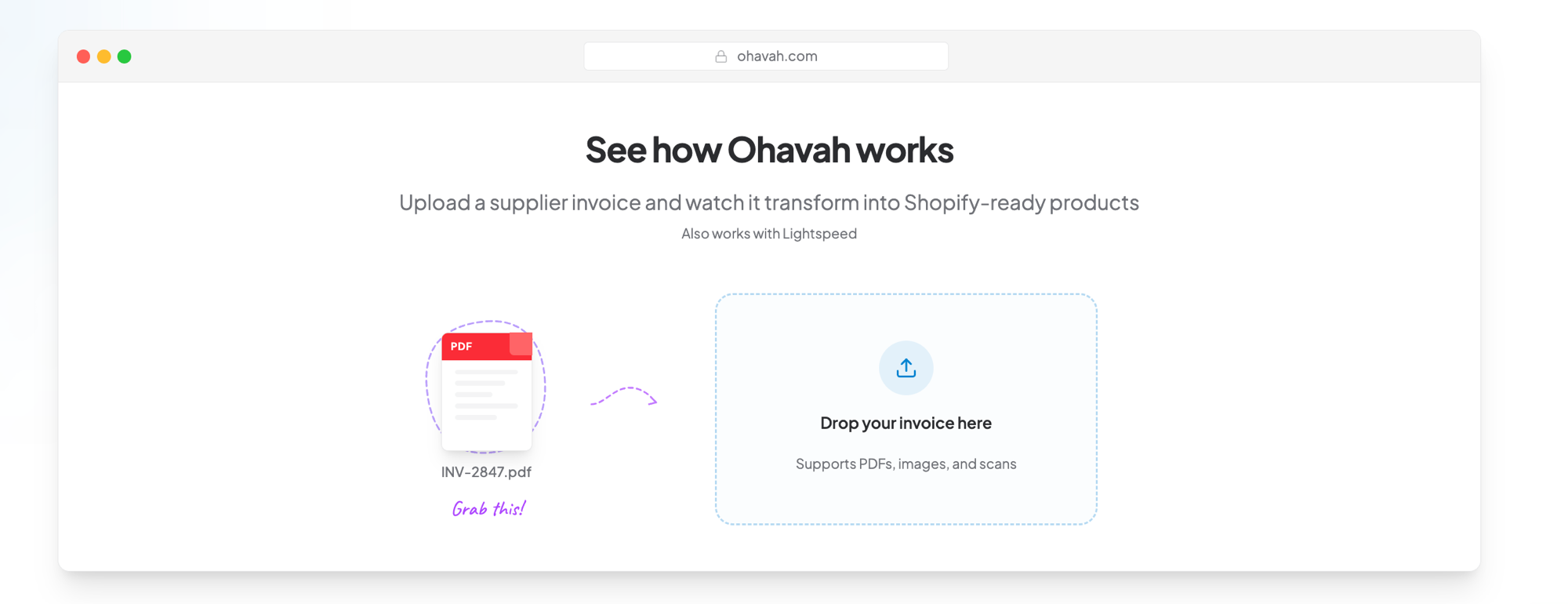
Ohavah takes that work off your plate. When you turn a supplier invoice into products, it reads each line item off the invoice, colors and sizes included, and builds your Shopify-ready product list in minutes instead of an afternoon. With the catalog already there, spinning up "Gifts Under $50" and "For the Hard to Shop For" is a quick sort on top of data you already have, so you spend the season merchandising the gift guide instead of keying it in.
Boutique owners talk about what moving off manual entry freed them up for over on our customer stories, where the holidays go back to being the fun part of the year again.
Sell to the gifter, not just the regular
Your regulars will find their way around your store no matter how you lay it out. The gift-buyer won't, and for six weeks there are a lot of them, holding a phone and a budget and the hope that you'll make this easy. Lead them to the pieces that are hard to get wrong, tell them the dimensions and the feel and how it's wrapped, and promise them a painless return, and you've turned the most anxious shopper of the year into one who leaves with a bag and comes back in January to swap a size, not to ask for their money back.
Check us out on socials
Boutique owners saving time and having more fun.
Try Ohavah free for 7 days and turn your supplier invoices into ready-to-list products in minutes, so your holiday buy is listed and sortable the day it lands and you can spend the season building the gift guide instead of typing it.
Stop entering products manually
Ohavah turns your supplier invoices into ready-to-import products automatically.