How Much Inventory Should a Boutique Actually Carry?
TL;DR
There's no magic dollar figure for how much inventory a boutique should carry, but there's a right amount for your store, and you find it by working backward from how fast you actually sell instead of guessing at a number that feels safe. The fundamentals come down to four ideas:
- Plan around inventory turns, not a lump sum; most healthy boutiques turn their stock two to four times a year
- Size each category to its own sales using a months-of-supply target, rather than splitting one flat budget evenly
- Go deep on a few brands per category instead of spreading thin across many
- Let your open-to-buy, not your bank balance, decide how much you bring in each month
Ohavah turns supplier invoices into ready-to-sell Shopify listings in minutes, and if you want a hand turning the math below into an open-to-buy plan built around your store, we do that too. Just get in touch.
Turn supplier invoices into products instantly
Skip the manual data entry. Upload a PDF, get ready-to-import products.
Every boutique owner asks some version of this question, usually while staring at a credit card statement or an empty-looking corner of the sales floor. Carry too little and the store feels picked over, the racks look thin, and customers leave without buying because there was nothing to choose from. Carry too much and you're back to the overstock problem, with cash frozen in product that won't move and a back room slowly filling up. The sweet spot is real, but it isn't a single number you can copy from another store, because it depends entirely on how fast your particular customers buy.
The good news is that the right amount is calculable. You don't need a merchandising degree, just a few ratios and the discipline to plan around them instead of around your gut.
Turns tell you more than a dollar amount
The first thing to understand is that "how much inventory" is asking the question slightly sideways. The number that actually matters is how many times you sell through and replace your stock in a year, a figure called inventory turnover, or turns.
A boutique turning its inventory four times a year is buying tighter, selling faster, and recycling the same dollar into fresh product four times over. One turning it twice is sitting on roughly double the stock to do the same sales, which means double the carrying cost and double the risk. Neither extreme is automatically right; a tightly edited store with a strong point of view can run lean on purpose, while a destination boutique known for its selection might carry more by design. But knowing your number tells you whether you're carrying your inventory or your inventory is carrying you.
To find it, divide your annual cost of goods sold by your average inventory at cost. If that lands somewhere around three, you're in healthy boutique territory. If it's under two, you're almost certainly holding more than your sales can justify.
Work backward from sales, category by category
Once you know your target turn rate, the amount to carry falls right out of it. A store turning four times a year is holding about three months of supply at any given moment; one turning three times holds four months. So if a category moves about $4,000 a month at cost and you want it turning four times, you want roughly $12,000 at cost on the floor and on order for it. Plan each category to its own sales rather than dividing one budget evenly, because your denim might turn twice as fast as your outerwear, and starving the quick category to feed the slow one is exactly how good sellers go out of stock while slow ones pile up.
This is also where GMROI earns its keep. Gross margin return on investment measures how many gross-margin dollars you earn for every dollar tied up in inventory, and it's the truest read on whether a category is pulling its weight. Two categories can ring up the same sales while one returns far more per dollar invested, and that one deserves a bigger share of your buy, not an equal slice.
How many brands per category?
Here's where it gets less mathematical and more a matter of taste, so treat what follows as a starting frame rather than a rule. The instinct for most new buyers is to carry a little of everything, a few pieces from as many lines as the market will show them, on the theory that more options means more chances to sell. In practice, breadth usually backfires. A category split across ten brands has no depth in any of them, so you're constantly out of the right size, no single line ever builds momentum, and the rack reads as a jumble instead of a point of view.
Going deep tends to win. A useful frame is to give each category one hero brand that anchors it and earns the most space, two or three supporting brands that round out your price points and styles, and maybe one wildcard you're testing in small quantity. That's roughly three to five brands per category with clear roles, rather than a dozen with none. Depth lets you carry full size runs, negotiate better terms, and actually learn whether a brand works before you've spread your bets so thin that nothing gets a fair chance. It also makes your decisions cleaner, because when it's time to tell which brands to reorder and which to drop, a concentrated assortment gives you real signal instead of noise.
The Pareto principle shows up here reliably; in most boutiques something like 80% of sales come from 20% of the brands. Carrying fewer brands more deeply is really just putting more of your money behind that productive 20% and less behind the long tail that was never going to earn its space.
Open-to-buy is the budget that actually matters
All of this comes together in a single planning tool that separates the boutiques that grow steadily from the ones that lurch between overbought and out of stock; the open-to-buy. Open-to-buy is simply how much new inventory you can bring in for a given month without blowing past your plan, and it's calculated from where you want to end the month rather than from how much cash happens to be in the account when a sales rep calls.
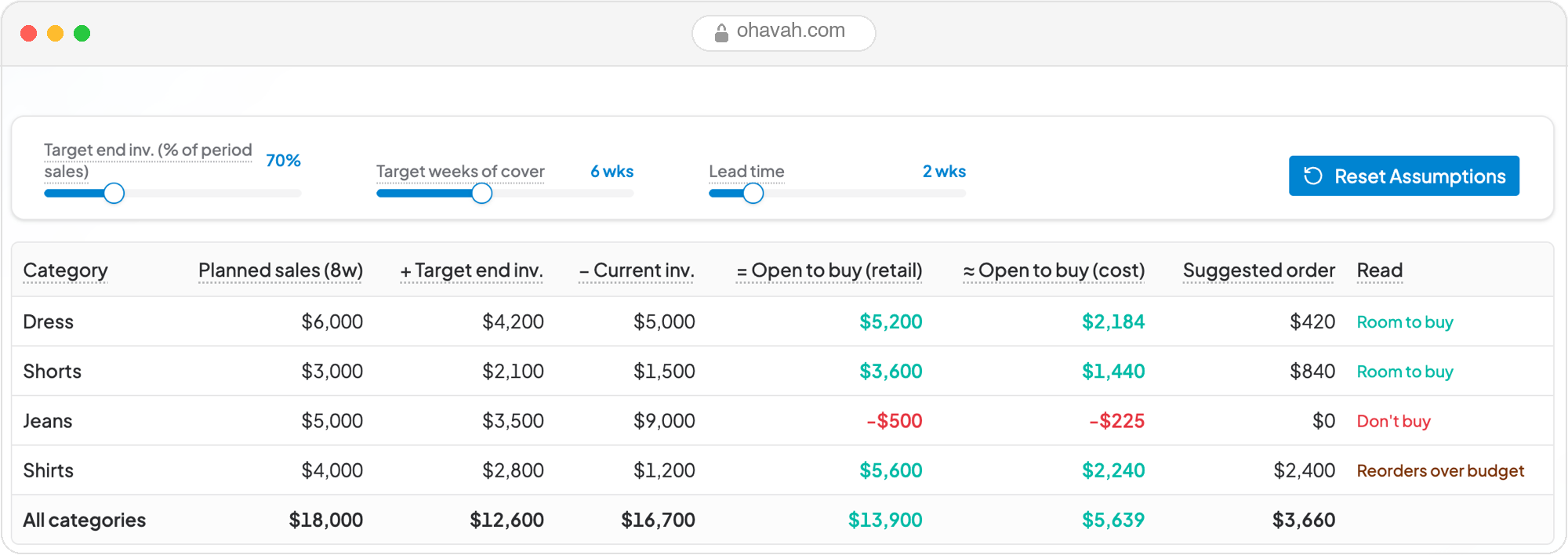
The math is straightforward. Take your planned sales for the month, add the inventory you want left at month's end and any planned markdowns, then subtract the inventory you're starting with. Whatever's left is what you're free to buy. Run it per category and you head off the two most common buying mistakes at once; overbuying a slow category because the line was pretty, and underbuying a hot one because you'd already spent the money elsewhere. We've written about the buying mistakes that happen before you even reach market, and nearly all of them trace back to walking the floor without an open-to-buy number in hand.
If you want to feel how those levers interact, we built a free interactive open-to-buy calculator. Slide the dials for target end inventory, weeks of cover, and lead time, and watch each category's buying budget update in real time.
Building an open-to-buy plan by hand in a spreadsheet works, and plenty of great buyers do exactly that. But it's fiddly to maintain across categories and easy to let slide once the season gets busy. If you'd like help setting one up around your store's real numbers, Ohavah can build an open-to-buy plan customized to your boutique, so you walk into market knowing exactly what you can spend in each category. Just get in touch and we'll put one together with you.
Too much and too little both have a price
It's worth being honest that erring in either direction costs you, just in different currencies. Carrying too much is the more familiar failure, and it's expensive in ways that compound; we broke down the hidden cost of overstock, from carrying charges to the markdown spiral to the winners you couldn't fund because your cash was frozen in last season's slow movers.
Carrying too little has a quieter cost that's easy to miss, because it never shows up as a write-down. Thin racks and frequent stockouts mean customers who walked in ready to buy leave empty-handed, and a shopper who finds her size missing twice tends not to come back for a third try. That lost sale never appears in your inventory report; it just shows up as traffic that didn't convert. The goal isn't to minimize inventory, it's to carry enough of the right things to meet demand while keeping your turns healthy.
The right number is the one you can defend
If there's a single takeaway, it's that the amount of inventory to carry should be the output of a plan, not an input you guess at. Pick a target turn rate, size each category to its own sales, go deep on a focused set of brands, and let open-to-buy govern every purchase. Do that and the question stops being "how much should I carry" and becomes "am I carrying the right things, at the right depth, turning at the rate I planned," which is a question you can actually answer with data.
And once you've decided what to bring in, the last mile is getting it selling everywhere fast, because inventory only earns its keep when it's in front of customers. Your website is a second sales floor, and product stuck in a back room waiting to be listed isn't carried inventory so much as buried inventory. Ohavah turns each new shipment's invoice into ready-to-publish Shopify listings in minutes, so the stock you planned so carefully actually goes to work the day it lands.
Try Ohavah free for 7 days, and if you'd like an open-to-buy plan built around your store, get in touch anytime.