How to Train Sales Associates to Sell Outfits, Not Just Pieces
TL;DR
A sales associate who sells a single top rings up one item. One who builds the whole outfit rings up three, and the customer walks out feeling styled rather than sold to. Teaching your team to sell looks instead of pieces is some of the highest-leverage training you can do, because it lifts units per transaction without a single markdown, it makes shoppers loyal to a person instead of a price, and it turns your store into the place people come when they don't know what to wear. The mechanics are learnable:
- Start with the customer's occasion, not the rack
- Anchor on one piece she loves, then build around it
- Put your team on the floor styling, not behind the register
- Give them the product knowledge to style with real confidence
Ohavah helps the outfits your team builds on the floor stay shoppable online too, getting new arrivals listed the same day so the look a customer fell for is one click away on your website, not stuck in a back-room shipment.
Turn supplier invoices into products instantly
Skip the manual data entry. Upload a PDF, get ready-to-import products.
Walk into most boutiques and the interaction goes the same way. A customer picks up a blouse, an associate says "that color's gorgeous on you," the customer agrees, buys the blouse, and leaves. One item, one transaction, a pleasant exchange that nobody remembers a week later. Nothing went wrong, exactly. It's just that a sale that could have been an outfit ended up being a single piece, and the customer who could have left with a head-to-toe look she's excited to wear left with a blouse she'll have to figure out how to style on her own.
The boutiques that consistently outsell their neighbors aren't the ones with better inventory or lower prices. They're the ones whose associates instinctively build the whole look. That instinct isn't a personality trait some people are born with; it's a sellable skill you can train. Here's how the best stores do it.
Why outfits beat pieces, in plain math
The number that matters here is units per transaction, or UPT, the average number of items in each sale. Most boutiques sit around 1.5. The ones with a strong styling culture run closer to 2.5 or 3. That gap is the entire difference between a flat month and a great one, and it costs you nothing in margin, because you're not discounting anything. You're selling more of what the customer already wants.
There's a well-documented reason outfit selling works, and it's called the Diderot Effect. The philosopher Denis Diderot noticed that after he was gifted a beautiful new robe, the rest of his study suddenly looked shabby by comparison, so he kept replacing things to match. One nice purchase pulls the others along with it. Your customer feels the same pull standing in your fitting room. The new wide-leg trousers make her current top look wrong, the right top makes her want the earrings, and the whole look makes her want the bag. An associate who understands this isn't pushing extras; she's resolving a tension the customer already feels.
The flip side is what happens when nobody builds the look. The customer takes home a single statement piece, gets home, realizes she has nothing to wear it with, and either returns it or lets it sit with the tags on. A complete outfit doesn't just sell more that day, it sticks, because she can actually wear it.
Start with the occasion, not the rack
The first thing to train out of a new associate is the reflex to talk about the garment in front of them, because the blouse isn't where a good sale starts. What matters first is where she's going to wear it.
Teach your team to open with the customer's life instead of the product. "What are you shopping for today, anything specific coming up?" A customer shopping for a daughter's graduation, a work conference, or a first date is a completely different sale than a customer browsing on a slow Saturday, and the outfit you build looks different for each. Once an associate knows the occasion, she's not selling a blouse anymore, she's solving "what do I wear to the rehearsal dinner," which is a problem the customer is genuinely grateful to hand off.
This is also how a single piece becomes three. The woman who needs a rehearsal-dinner outfit needs the dress, but she also needs the wrap for the cool evening, the shoes she can stand in, and the earrings that photograph well. Build around the event and the add-ons sell themselves, because every one of them answers a real question she walked in with.
The anchor-and-build method
Once your associate knows the occasion, the technique itself is simple enough to teach in an afternoon. Find the anchor, the one piece the customer is clearly drawn to, and build outward from it.
The anchor is whatever made her stop and touch the fabric. Maybe it's a printed midi dress, maybe it's a great pair of jeans. Don't argue with the anchor or try to redirect it; that's the piece she's emotionally committed to, and it's the foundation everything else hangs on. From there, the associate's job is to bring options to the fitting room, not send the customer back out to hunt. Pull the two tops that work with the jeans, the jacket that finishes them, the necklace that changes the neckline. Bring three or four pieces and let the mirror do the selling.
A few rules worth drilling into the team:
- Always bring more than she asked for. If she's trying on a dress, the wrap and the shoes go into the fitting room with it. Nobody buys an add-on they never saw on their body.
- Style head to toe, every time. A look that stops at the waist doesn't read as an outfit. Shoes, a bag, a layer, and jewelry are what turn pieces into a look she can picture wearing.
- Show, don't describe. "This jacket would look great with it" is weak. Handing her the jacket and watching her put it on is the sale.
Put your team on the floor, not behind the register
You can teach every technique above and still see no change in UPT if your associates spend the night standing at the counter waiting to ring people up. Outfit selling happens on the floor, in the fitting room, at the mirror. It can't happen from behind the register.
The shift here is cultural as much as it is procedural. Make it clear that the job is styling, and that the register is the last thirty seconds of a sale, not the place you live. The strongest boutique teams treat the fitting room as their office; they're in and out of it constantly, swapping sizes, bringing the next option, checking the look. That constant, attentive presence is exactly what makes a customer feel cared for instead of upsold, and it's the same presence that builds the kind of loyal regular who comes back asking for a specific associate by name. When a shopper starts requesting "is Emily working today," you've stopped competing on price entirely; she's loyal to a person and a feeling, not a markdown.
Confidence comes from knowing the product
Here's the part that quietly separates a good styling team from a great one. An associate can only build a convincing outfit if she actually knows what's on the floor, what pairs with what, which fabrics drape together, which brand runs small, and why a particular piece is worth its price. A team that knows the inventory cold styles fast and sounds sure of itself, and certainty is contagious. A team that's guessing hedges, suggests less, and the customer feels it.
This is why outfit selling and product knowledge are really two halves of the same skill, and it's worth training them together. We dug into the deeper version of this in why product knowledge matters more than pushy selling, but the short version for styling is that the more your team genuinely understands the brands and pieces you carry, the better and faster the outfits they can build, and the less any of it feels like a pitch.
Make the outfits shoppable online, too
There's a leak in even the best-trained styling floor, and it shows up after the customer goes home. She loved the full look she tried on, but she only bought the dress that night and wanted to think about the jacket. Or her friend saw the outfit on Instagram and wants the whole thing. If those companion pieces aren't on your website, the styling work your team did in the store quietly dies the moment she walks out the door.
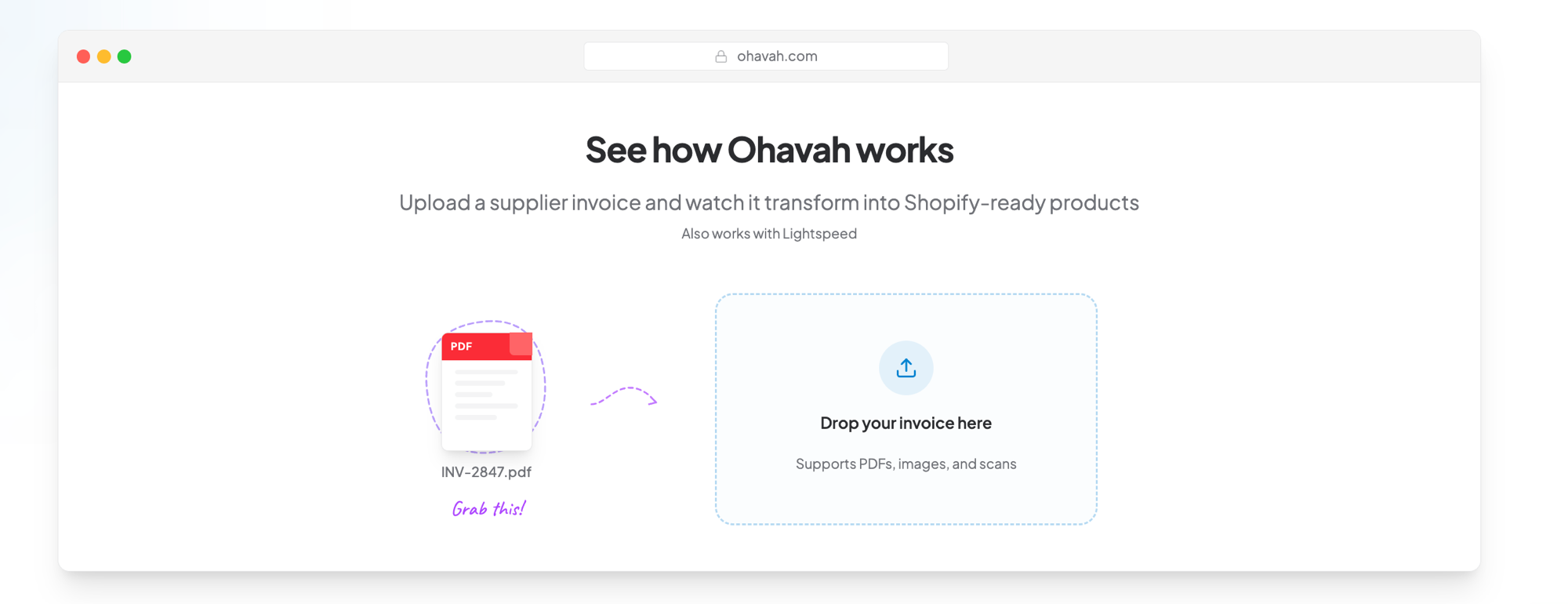
Your online store should carry the same looks your associates build on the floor, which means new arrivals have to actually be listed and live. For most boutiques that's the bottleneck, because photographing, naming, pricing, and uploading a fresh shipment takes hours, so the pieces your team is styling this week often don't hit the website until next week, long after the customer's interest has cooled. Your online store is your second location, and it should stock the same outfits your best associate is putting together in person. Ohavah turns the supplier invoice for a new shipment into ready-to-publish Shopify listings in minutes, so the jacket she wanted to sleep on is online and buyable that same night, while she's still thinking about it.
The training playbook
- Train UPT, not transactions. Make units per transaction a number your team watches and celebrates, so styling becomes the goal instead of just ringing people up.
- Open with the occasion. Every interaction starts with where she's going, not with the garment in her hand.
- Anchor and build. Find the piece she loves, then bring the full look to the fitting room so the mirror does the selling.
- Live on the floor. Styling happens at the fitting room and the mirror; the register is the last thirty seconds.
- Feed them product knowledge. Confident styling depends on a team that truly knows the brands and pieces you carry.
- Mirror the looks online. Use Ohavah to get new arrivals listed same-day, so the outfits built in store are shoppable on your website before the moment passes.
Train your team to sell the look instead of the label, and two things happen at once. Your average sale climbs without a single price cut, and your customers start coming back for the person who styled them, which is the kind of growth no competitor can discount their way past.
Try Ohavah free for 7 days and keep the outfits your team builds on the floor shoppable online the same day.